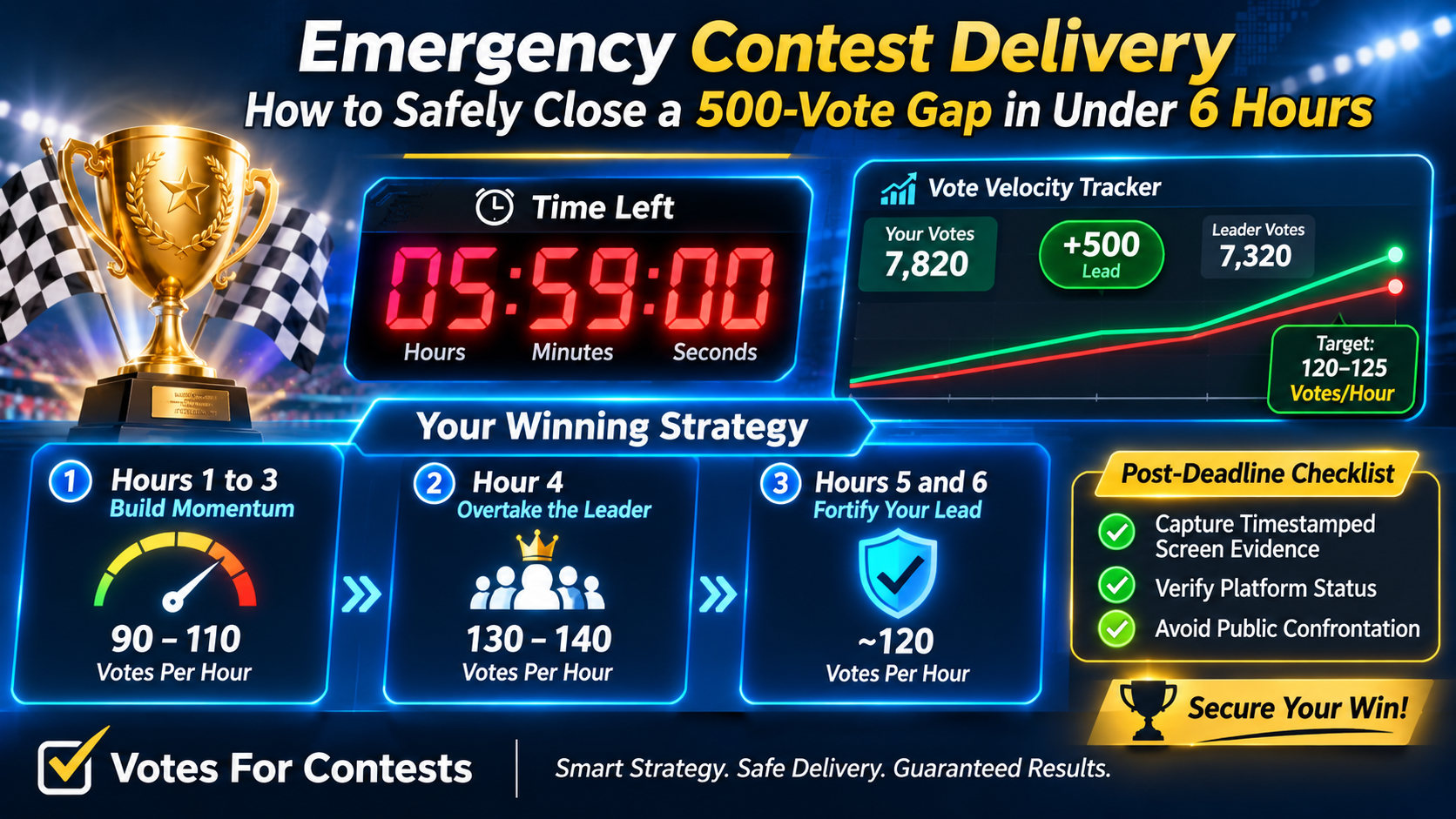
Finding yourself trailing behind the leader in the final six hours of an online competition is an intense, high-pressure scenario. Whether you are competing in a local business award, an ambassador poll, or a national creative contest, a 500-vote deficit often looks impossible to overcome through ordinary social media posts alone.
When time is running out, amateur contestants often panic. They either give up completely or resort to automated scripts that dump hundreds of votes into the ballot in minutes. Both reactions lead to the same outcome: losing the prize or getting flagged by contest moderators.
Closing a substantial vote gap under tight deadlines requires an exact operational balance. At Votes For Contests, we help contestants navigate high-stakes contest deadlines with structured, human-verified distribution. Below is the tactical playbook for pacing entries, managing platform velocity thresholds, and overtaking the leader without triggering audit flags.
The Mathematics of a 6-Hour Turnaround
Overcoming a 500-vote deficit is fundamentally a math problem. If you simply aim for 500 votes, you will almost certainly fall short because the current leader is also accumulating votes.
To calculate your actual hourly target, apply this emergency formula:
Required Run Rate=Current Deficit+(Competitor Hourly Rate×Hours Left)+BufferHours LeftRequired Run Rate=Hours LeftCurrent Deficit+(Competitor Hourly Rate×Hours Left)+Buffer
Assuming your competitor gains an average of 25 votes per hour and you require a 75-vote safety buffer to prevent a photo-finish tie:
Current Deficit: 500 votes
Competitor Projected Influx: 25×6=150 votes25×6=150 votes
Safety Buffer: 75 votes
Gross Target Volume: 500+150+75=725 votes500+150+75=725 votes
Target Delivery Rate: ~120 to 125 votes per hour
Breaking down the surge into hourly targets allows you to maintain consistent pressure on the leaderboard while staying safely under automated rate-limiting thresholds.
Velocity Limits: Drip-Feed vs. Uncontrolled Surge
Online voting engines like Woobox, Wishpond, and custom polling software monitor incoming request velocity. Every platform establishes dynamic thresholds based on typical contest engagement. Violating these thresholds triggers automated circuit breakers that temporarily freeze vote tallies.
An unnatural spike occurs when hundreds of submissions register with identical time deltas (e.g., precisely one vote every 1.2 seconds). An audit-safe delivery model introduces natural micro-delays, randomizing intervals between 15 and 90 seconds to simulate authentic human voting clusters.
How to Safely Execute a Last-Minute Lead Change
Executing a rapid turnaround in the final hours requires coordinating your distribution strategy with extreme discipline:
1. Front-Load the Foundation in Hours 1 to 3
Start your campaign by establishing a steady run rate of 90 to 110 votes per hour. This begins cutting down the deficit without alerting your competitor too early. If you surge past them immediately in hour one, they may mobilize counter-measures or alert their own networks.
2. Overtake the Leader in Hour 4
Accelerate your pace to 130–140 votes per hour during the fourth hour. This is the strategic inflection point where you erase the remaining gap and establish a 30- to 50-vote lead.
3. Fortify Your Lead in Hours 5 and 6
Competitors who notice they have been overtaken in the final two hours often attempt an unorganized surge. Maintain a consistent delivery of 120 votes per hour right up to the final 15 minutes before the voting portal locks.
When every minute counts, relying on unvetted methods creates serious risks. Choosing to buy contest votes fast delivery through Votes For Contests guarantees that your emergency entries are routed through genuine residential connections,providing the exact velocity required to secure first place without risking post-contest disqualification.
Post-Deadline Checklist: Locking In Your Win
Once the countdown timer hits zero and voting officially closes, take these immediate actions:
Capture Timestamped Screen Evidence: Immediately record a full-page desktop screenshot and screen recording of the final standings, showing your name, final vote count, and system clock.
Verify Platform Status: Check whether the contest displays an “Official Results Pending Audit” badge. Platforms typically run automated log purges within the first 2 hours post-deadline.
Avoid Public Confrontation: Do not engage in public forum or social comment disputes with trailing competitors.Let your verified ballot logs speak for themselves.