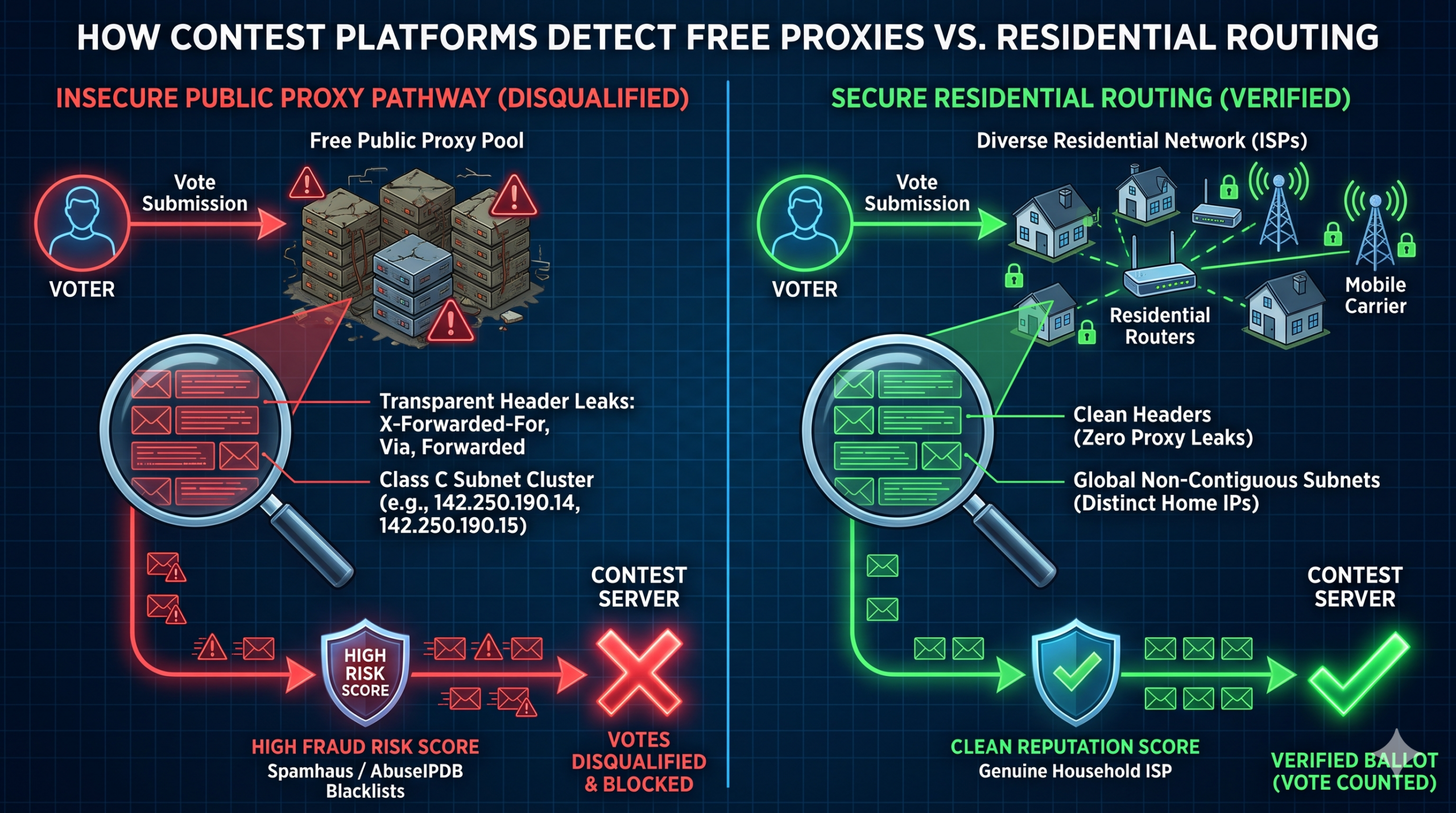
When competing in high-stakes online voting contests, many participants attempt to solve duplicate voting restrictions by using free public proxies or web-based proxy scrapers. On the surface, the logic seems straightforward: if a platform allows only one vote per connection, rotating through a list of public proxies should theoretically produce hundreds of valid ballots.
In reality, deploying public proxies is one of the fastest ways to get your votes stripped or your entry permanently removed from a competition. Modern voting platforms use automated security stacks that inspect incoming traffic far beyond surface-level IP numbers.
At Votes For Contests, we evaluate contest security architectures to ensure votes pass backend platform audits seamlessly. Below is a detailed look at why free proxy lists fail, how contest servers detect them, and how residential routing protects your campaign.
The Technical Reality Behind Free Proxy Networks
Free proxies advertised on public scraping websites are almost exclusively misconfigured commercial web servers, vulnerable open relays, or datacenter nodes. Because they are open to the global internet, hundreds of automated bots, scraping scripts, and spam operations hit these connections simultaneously every minute.
When a participant routes contest votes through these open lists, several critical technical vulnerabilities expose the activity immediately:
1. Transparent Header Leaks
Most public proxies operate as “transparent” or “anonymous” relays rather than truly elite proxies. Transparent proxies inject intermediate network headers into web requests, such as:
X-Forwarded-For: [Your Actual IP]
Via: [Proxy Server Software & Port]
Forwarded: for=[Client IP];proto=http;by=[Proxy]
When an entry hits a platform like Woobox, Wishpond, or StrawPoll, the receiving server reads these headers instantly. Even if the remote proxy IP appears unique, the X-Forwarded-For header hands over your originating IP or signals that a proxy script is mediating the connection, triggering immediate vote rejection.
2. High Fraud Risk Scores & Shared Blacklists
Major cybersecurity databases such as Spamhaus, AbuseIPDB, and MaxMind maintain real-time threat intelligence feeds. The moment an open proxy appears online, it is automatically catalogued and assigned a high fraud risk score. Contest platforms subscribe to these exact fraud intelligence APIs. When a ballot arrives from a known open relay, the vote is discarded before it ever updates the public tally.
Class C Subnet Clustering: How Platforms Catch Batch Voting
A common error among contestants is buying or scraping an IP package that shares identical network subnets. IP addresses are structured in four octets (A.B.C.D):