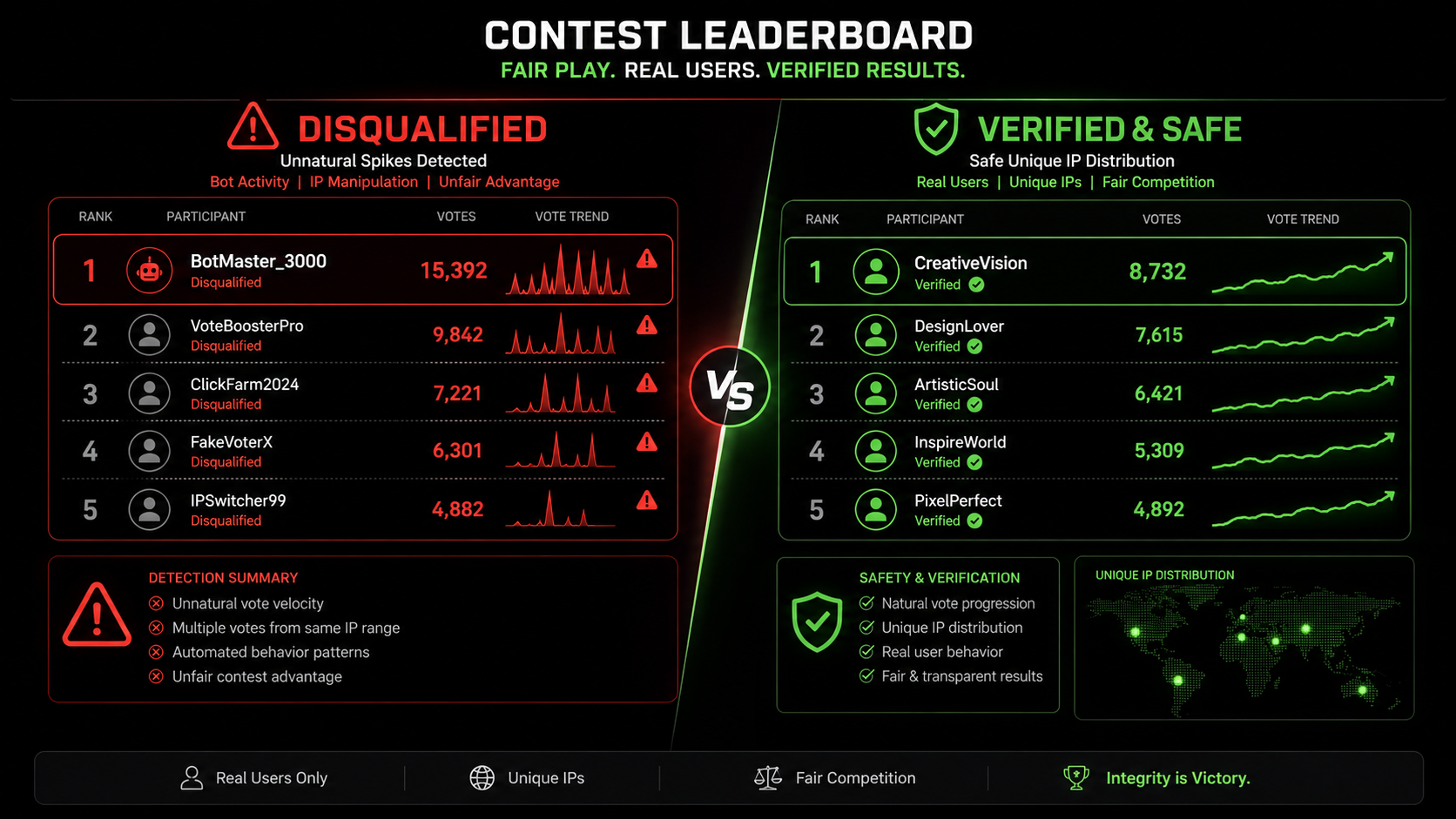

Participating in an online contest requires strategic dedication, audience mobilization, and continuous tracking. However, nothing is more frustrating for a contestant than seeing hundreds of hard-earned votes suddenly removed or, worse, receiving a notification of complete contest disqualification right before the winner is announced.
Modern digital contests deploy advanced anti-fraud filters and automated auditing systems to maintain fairness. When a campaign triggers security thresholds, contest administrators do not hesitate to strip illegitimate or flagged entries from the tally.
Understanding the underlying reasons behind vote disqualification—and knowing how to safeguard your submissions—is the single most effective way to ensure your efforts translate into a verified win.
The Top 5 Reasons Contest Organizers Reject Entries
Contest platforms utilize layered security protocols that analyze every incoming interaction. The most common triggers that lead to vote rejection include:
Duplicate IP Submissions: When dozens or hundreds of votes originate from the same local network, public Wi-Fi hub, or shared IP subnet, anti-fraud algorithms flag the cluster as duplicate voter manipulation.
Datacenter and Proxy IP Routing: Using free web proxies or commercial VPNs routes traffic through data centers rather than authentic residential internet service providers (ISPs). Security firewalls immediately identify these hosting-provider IP ranges and blacklist the votes.
Incomplete Authentication Pathways: In contests requiring email confirmations, phone OTPs, or social media logins, unverified accounts or temporary disposable email addresses fail manual backend audits, resulting in mass vote drops.
Browser Fingerprint Duplication: Even if an IP changes, identical browser canvas hashes, matching screen dimensions, and repetitive hardware profiles reveal that multiple submissions originated from a single device.
Unnatural Interaction Speed: Submissions that complete complex voting flows within milliseconds without natural cursor movement, page scrolling, or human dwell time trigger automated bot filters.
Understanding Velocity Triggers: Why Sudden Spikes Cause Audits
One of the most overlooked factors in online voting is velocity anomaly tracking. Contest algorithms establish a statistical baseline of normal voting speed across all participants.
| Feature / Metric | Natural & Safe Growth Pattern | Unnatural Spike (Audit Trigger) |
|---|---|---|
| Delivery Pacing | Gradual hourly climb with organic curve | Sudden surge of 500+ votes in 5 minutes |
| Active Time Windows | Consistent with local regional daytime | Heavy voting activity during 3:00 AM off-peak hours |
| Network Origins | Diverse residential ISP connections | Clustered submissions from a single server or subnet |
| User Interaction | Mixed dwell times (15s to 45s per voter) | Identical millisecond completion times across all entries |
| Security Response | 100% verified status approved | Automatic vote freeze, audit flag, or disqualification |
When an entry experiences an abrupt surge of hundreds of votes within a matter of minutes—especially during off-peak hours—the platform’s security system automatically flags the contestant for a manual audit. Even if a contestant is running a legitimate promotional campaign, excessive velocity without organic variance can cause an automatic vote freeze.
How Clean IP Address Diversity Guarantees Submission Safety
To protect your position against security audits, your campaign must reflect genuine human behavior across distinct network connections. Contest auditing scripts primarily examine the network origin of every logged ballot.
When you secure entries supported by genuine unique IP address voting, each vote is routed through a clean, separate residential connection. This prevents multi-vote clustering, preserves natural geographic diversity, and satisfies platform verification filters.
By ensuring that every entry originates from an authentic IP with distinct browser headers and session cookies, your vote tally remains resilient against automated sweeps and manual administrative reviews.
Essential Checklist to Audit Your Voting Strategy Before Deadlines
Before entering the final stretch of any online competition, run through this practical checklist to protect your campaign from sudden penalties:
Review Contest Verification Rules: Identify whether the platform requires simple one-click verification, unique IP validation, email confirmation, or Facebook social authentication.
Avoid Unvetted Proxy Services: Never deploy free proxy scripts, automated browser extensions, or low-cost datacenter traffic bots that leave identifiable server footprints.
Distribute Submission Pacing: Schedule entries to arrive steadily over hours or days rather than executing a high-risk surge all at once.
Maintain Process Transparency: Ensure every submission leaves a verifiable trail that matches real-world browsing metrics and device profiles.
Monitor Hourly Vote Tallies: Keep a log of your vote progression alongside competitor movements to detect abnormal drops early and adjust delivery speeds safely.